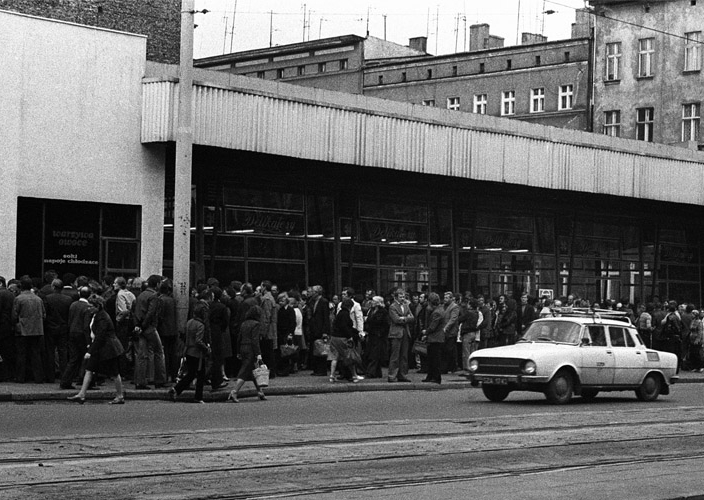
The exhibition is a photographic record of the twilight years of the Polish People’s Republic – a time when most Poles were not yet aware that the end of the socialist system was near. The photographs depict Polish life at the turn of the 1970s and 1980s, using Szczecin as an example, and document the phenomena characteristic of that era: long queues, omnipresent disorder and mediocrity, but also the ways in which people coped with the hardships of everyday life.
The photographs also capture significant landmarks in Szczecin which today look completely different or have vanished from the city map altogether.
The time of ‘Solidarity’ Trade Union’s activity and the first months of martial law take a special place in the exhibition. The history of this ten-million-strong social movement is brought to life through portraits of its leaders and young opposition activists. Meanwhile, the dramatic experiences of martial law are interwoven with events that offered a respite from the grim reality of those days – such as the wedding of one of the interned women. The photographer, Ryszard Dąbrowski, captured what was important, private and unique. Devoid of pathos, the photographs paint a poignant picture of the final decade of the Polish People’s Republic, seen from the perspective of Szczecin and its inhabitants.
Ryszard Dąbrowski – participant in the student demonstrations at the Adam Mickiewicz monument in Szczecin in 1968. A graduate of the Technical University of Szczecin University. A designer at the Design and Construction Office at the A. Warski Shipyard in Szczecin. From 1977, he was associated with Andrzej Milczanowski’s group, distributing leaflets, independent publications and underground books. He was under surveillance by the Security Service (SB). A trade union activist and ‘Solidarity’ documentarian: author of socially critical photographic exhibitions. Following the imposition of martial law, he took part in the strike at the ‘Warski’ shipyard. After the shipyard was pacified, he was dismissed and worked as a locksmith. An underground activist. Among other things, he produced identity photographs for people in hiding from the Security Service. He was the author of posters and leaflets for the underground ‘Solidarity’ movement and a distributor of independent publications. He co-organised the smuggling of a camera into the Detention Centre in Wierzchowo, where interned ‘Solidarity’ activists were being held. On 11 May 1982, together with Henryk Wilkocki, he scattered several dozen leaflets from the roof of a high-rise block at 33 Niepodległości Avenue, opposite the Provincial Committee of the Polish United Workers’ Party (PZPR) in Szczecin. From December 1982, he lived in exile in West Germany, where he worked on behalf of ‘Solidarity’ by organising exhibitions and collaborating with émigré publications and Radio Free Europe.